


If you’ve spent any time in the world of psychedelics and wellness, you’ve almost certainly come across the name Paul Stamets. A mycologist, author, and passionate advocate for the healing power of fungi, Stamets has spent decades exploring the extraordinary world of mushrooms. But it is his development of a specific microdosing protocol — known as the “Stamets Stack” — that has perhaps had the greatest impact on the popular conversation around psychedelics and cognitive enhancement.
This article is part science, part personal experiment. Because in February 2025, I decided to try it myself.
What Is the Stamets Stack?
The Stamets Stack is a microdosing protocol that combines three key ingredients, each chosen for its specific neurological benefits:
1. Psilocybin (microdose) — The active compound in “magic mushrooms.” At sub-perceptual doses (typically 0.1g to 0.3g of dried mushrooms), psilocybin is believed to promote neuroplasticity and enhance mood without producing a full psychedelic experience. Research has shown that even at low doses, psilocybin can stimulate the growth of new neural connections.¹
2. Lion’s Mane Mushroom (Hericium erinaceus) — A non-psychoactive medicinal mushroom with remarkable nootropic properties. Lion’s Mane has been shown to stimulate the production of Nerve Growth Factor (NGF), a protein essential for the growth, maintenance, and survival of neurons.² A 2023 study from the University of Queensland found that lion’s mane compounds enhanced nerve cell growth and improved memory formation in preclinical models.³
3. Niacin (Vitamin B3) — The “flush” form of niacin, which causes a temporary reddening and tingling of the skin. Stamets theorizes that niacin’s vasodilatory effect helps distribute the psilocybin and lion’s mane compounds to the peripheral nervous system, extending their reach beyond the brain.⁴ While this specific mechanism hasn’t been fully validated in clinical trials, niacin’s role in cellular energy metabolism and DNA repair is well established.⁵
The protocol typically follows a schedule of 4 days on, 3 days off, repeated over several weeks. Stamets has discussed this protocol extensively, including in his appearance on the Joe Rogan Experience and at various mycology conferences.⁶
My Personal Experiment: February 2025
I want to be upfront: this is not medical advice. This is one person’s honest account of a self-directed experiment, tracked as carefully as I could manage.
In February 2025, I ran a 30-day experiment with the Stamets Stack. My dosage ranged from 0.1g to 1g of psilocybin (I experimented across the range to find what felt right), combined with lion’s mane and niacin as per the protocol. I followed the 4-on, 3-off schedule.
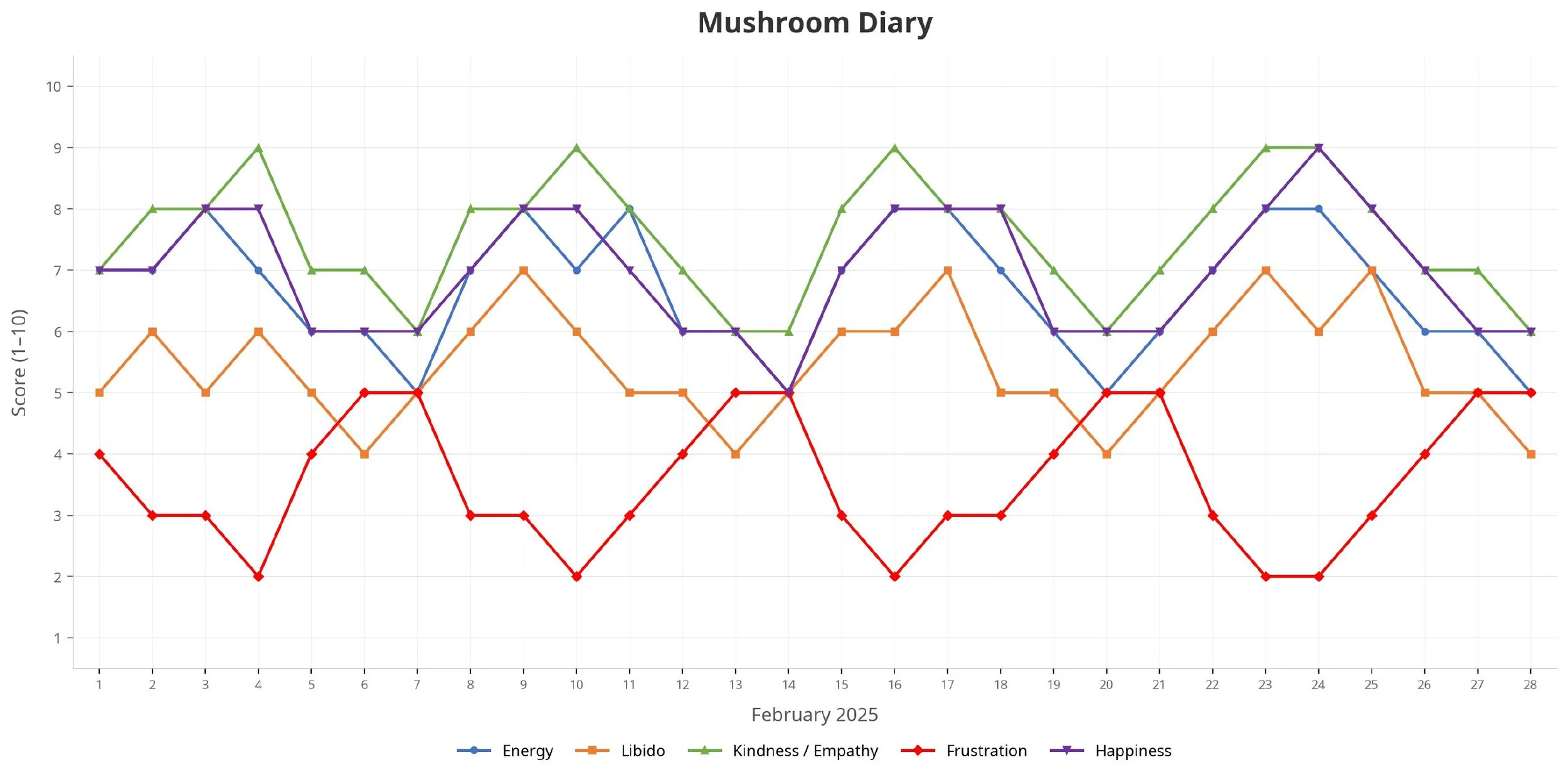
Every day, I tracked five metrics on a simple 1–10 scale:
• Energy — How physically and mentally energized I felt throughout the day
• Libido — General sense of vitality and desire
• Kindness/Empathy — How connected and compassionate I felt toward others
• Frustration — How easily irritated or frustrated I became (lower is better)
• Happiness — Overall sense of well-being and contentment
What I Noticed
The effects were subtle but consistent. I didn’t experience anything close to a psychedelic effect — no visuals, no altered perception. What I noticed was more like a gentle lifting of the baseline. Colors seemed slightly more vivid. Conversations felt a little more engaging. I found myself more patient with my team, more present with friends, and generally more “on” without the jittery edge of caffeine.
Energy saw a noticeable uptick, particularly on days 2–4 of each cycle. Kindness and empathy were the most consistently elevated metrics — I found myself genuinely more interested in other people’s experiences and less reactive to minor annoyances. Frustration dropped, though I can’t fully separate that from the general mood improvement. Happiness was modestly but reliably higher.
Libido was the most variable and hardest to attribute directly to the stack.
The Honest Conclusion: 20% Boost or Placebo?
After 30 days, my honest assessment is that the Stamets Stack provided roughly a 20% boost to my overall baseline across these metrics. That’s meaningful — it’s the difference between a good day and a great day, between reacting and responding.
But I have to be honest about the elephant in the room: the placebo effect. When you’re actively tracking your mood and you’re taking something you believe might help, it’s genuinely difficult to separate the pharmacological effect from the psychological one. Research on microdosing has grappled with exactly this question. A rigorous 2021 self-blinding study published in eLife found that while microdosers reported significant improvements in well-being, the improvements were not significantly different from placebo.⁷
Does that mean it’s “just” placebo? I’m not sure that’s the right framing. If the ritual of intentional self-care — of taking something each morning with the conscious intention to be more present, more kind, more energized — produces real, measurable improvements in how you feel and how you show up in the world, does it matter whether the mechanism is purely pharmacological?
That said, the preclinical science is genuinely compelling. The neuroplasticity research on psilocybin is robust.⁸ The NGF-stimulating properties of lion’s mane are well-documented.⁹ And the combination — even if the synergistic effects Stamets proposes haven’t been fully validated in human trials — is grounded in sound biological reasoning.
Where the Research Stands
It’s important to note that while the individual components of the Stamets Stack have varying degrees of scientific support, the specific combination protocol has not yet been tested in a controlled clinical trial. The microdosing field is still young, and the research is catching up to the enormous public interest.
What we do know is encouraging. Psilocybin microdosing studies, while mixed on the placebo question, consistently report improvements in mood, creativity, and cognitive flexibility.¹⁰ Lion’s mane continues to show promise in both preclinical and early clinical research for cognitive enhancement and neuroprotection.¹¹ And the broader psychedelic research renaissance is producing increasingly rigorous evidence for the therapeutic potential of these compounds.
My personal takeaway? The Stamets Stack is worth exploring — with intention, with respect, and with realistic expectations. It’s not a magic pill. It’s more like a gentle nudge in the right direction. And sometimes, a nudge is all you need.
___
References
¹ Ly, C., Greb, A. C., Cameron, L. P., et al. (2018). Psychedelics Promote Structural and Functional Neural Plasticity. Cell Reports, 23(11), 3170-3182.
² Mori, K., Obara, Y., Hirota, M., et al. (2008). Nerve growth factor-inducing activity of Hericium erinaceus in 1321N1 human astrocytoma cells. Biological and Pharmaceutical Bulletin, 31(9), 1727-1732.
³ Martínez-Marmol, R., Chai, Y., Conroy, J. N., et al. (2023). Hericerin derivatives activates a pan-neurotrophic pathway in central hippocampal neurons converging to ERK1/2 signaling enhancing spatial memory. Journal of Neurochemistry, 165(6), 791-808.
⁴ Stamets, P. (2018). Psilocybin Mushrooms and the Mycology of Consciousness. Presentation at Psychedelic Science Conference.
⁵ Kirkland, J. B., & Meyer-Ficca, M. L. (2018). Niacin. Advances in Food and Nutrition Research, 83, 83-149.
⁶ Stamets, P. (2017). Appearance on The Joe Rogan Experience, Episode #1035.
⁷ Szigeti, B., Kartner, L., Blemings, A., et al. (2021). Self-blinding citizen science to explore psychedelic microdosing. eLife, 10, e62878.
⁸ Shao, L. X., Liao, C., Gregg, I., et al. (2021). Psilocybin induces rapid and persistent growth of dendritic spines in frontal cortex in vivo. Neuron, 109(16), 2535-2544.
⁹ Lai, P. L., Naidu, M., Sabaratnam, V., et al. (2013). Neurotrophic properties of the Lion’s mane medicinal mushroom, Hericium erinaceus. International Journal of Medicinal Mushrooms, 15(6), 539-554.
¹⁰ Anderson, T., Petranker, R., Christopher, A., et al. (2019). Psychedelic microdosing benefits and challenges: an empirical codebook. Harm Reduction Journal, 16(1), 43.
¹¹ Saitsu, Y., Nishide, A., Kikushima, K., et al. (2019). Improvement of cognitive functions by oral intake of Hericium erinaceus. Biomedical Research, 40(4), 125-131.