

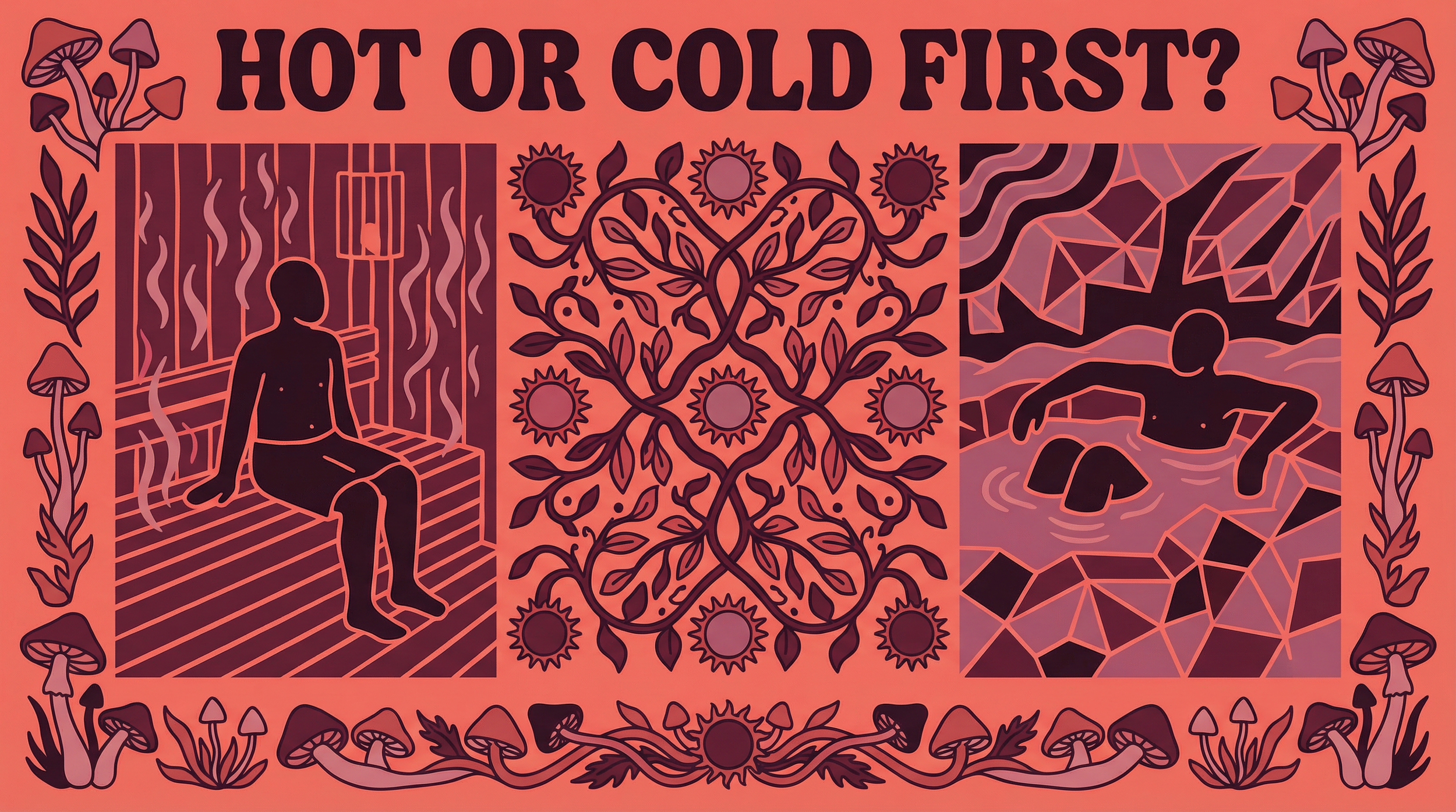
Have you ever stood in front of an ice bath, shivering just looking at it, wondering if you really have to get in before you hit the sauna? Or maybe you're sweating through a summer day and the thought of stepping into a 90-degree wooden box sounds like absolute torture.
One of the most common questions we get at the Hot Cold Club is: "Which one should I do first?"
If you're looking for a rigid, one-size-fits-all rule, I'm going to disappoint you. The truth is, it depends. And honestly, I let the seasons—and my own intuition—guide me.
Here's how I personally approach it. In the dead of winter, when the air is crisp and I'm already bundled up, the thought of plunging into freezing water right away just isn't appealing. So, I start with the heat. I let the sauna warm my bones, melt away the tension, and get my body craving that cold plunge.
But in the summer? When I'm already running hot and the Lisbon sun is beating down, I love to start cold. Stepping into the ice bath when you're already overheated feels like an absolute reset. It's what my body intuitively asks for, and I've found that listening to that intuition usually leads to the best experience.
My Winter Pro Tip
If you're like me and prefer starting hot during the colder months, here's a little trick I swear by: finish your session with a very quick splash of cold. I'm talking just a few seconds. This way, you maintain that deep sense of peace and warmth you built up in the sauna, but you still walk away with that undeniable, clear-headed energy boost that only the cold can give you. It's the best of both worlds.
What the Science Actually Says
Now, while I'm a big believer in doing what feels right, it's always good to know what's happening under the hood. The research on contrast therapy is fascinating, and it turns out there are profound physiological benefits to both approaches.
Starting Hot (Sauna to Ice Bath)
This is the traditional Nordic way. When you start in the sauna, your blood vessels dilate, your heart rate increases, and your muscles deeply relax. The intense heat stress activates heat shock proteins (HSPs), particularly HSP70, which provide cellular protection and anti-inflammatory effects.¹ A landmark 20-year study of over 2,300 Finnish men demonstrated that frequent sauna use (4-7 times per week) is associated with a 63% lower risk of sudden cardiac death compared to once-a-week use.²
Moving from this intense heat into the cold causes your blood vessels to rapidly constrict. This dramatic shift acts like a pump for your cardiovascular system, flushing out metabolic waste and flooding your body with fresh, oxygen-rich blood. It's fantastic for muscle recovery and gives you that massive rush of endorphins and adrenaline.
Starting Cold (Ice Bath to Sauna)
On the flip side, starting with the cold plunge triggers an immediate stress response. Your body works hard to protect your core temperature, which spikes your alertness and focus. Research has shown that cold water immersion (around 14°C) can increase plasma norepinephrine by 530% and dopamine by 250%.³ This massive neurochemical release is why you feel so incredibly sharp and energized after a plunge—an effect that neuroscientist Andrew Huberman notes can last for hours.⁴
Furthermore, cold exposure induces the expression of cold shock proteins, such as RBM3, which have been shown in recent studies to promote synaptogenesis (the formation of new neural connections) and offer significant neuroprotective benefits.⁵
When you transition into the sauna afterward, the heat feels incredibly comforting. The slow rewarming process allows your blood vessels to gently open back up, promoting a deep, restorative relaxation. This sequence is often favored by people looking to build mental resilience first, followed by a soothing recovery.
Ultimately, the "maze" of hot and cold therapy isn't really a maze at all—it's a playground. Whether you want to follow the science, follow the seasons, or just follow your gut, the most important thing is that you're showing up and doing the work.
So, next time you're at the club, ask yourself: what does my body need today? Then go do exactly that.
___
References
¹ Laukkanen, J. A., Laukkanen, T., & Kunutsor, S. K. (2018). Cardiovascular and Other Health Benefits of Sauna Bathing: A Review of the Evidence. Mayo Clinic Proceedings, 93(8), 1111-1121.
² Laukkanen, T., Khan, H., Zaccardi, F., & Laukkanen, J. A. (2015). Association Between Sauna Bathing and Fatal Cardiovascular and All-Cause Mortality Events. JAMA Internal Medicine, 175(4), 542-548.
³ Šrámek, P., Šimečková, M., Janský, L., Šavlíková, J., & Vybíral, S. (2000). Human physiological responses to immersion into water of different temperatures. European Journal of Applied Physiology, 81(5), 436-442.
⁴ Huberman, A. (2022). Using Deliberate Cold Exposure for Health and Performance. Huberman Lab Podcast.
⁵ Peretti, D., Smith, H. L., Verity, N., et al. (2021). TrkB signaling regulates the cold-shock protein RBM3-mediated neuroprotection. Life Science Alliance, 4(4), e202000884.